When a person goes into sudden cardiac arrest outside of a health care facility, there is a specific sequence of events that, if performed fully and efficiently, can significantly improve their chances of survival and recovery. This is known as the Out-of-Hospital Chain of Survival.
According to the American Heart Association, there are six steps in this process. Each step is vitally important to a cardiac arrest patient’s survival. It’s important to understand the chain and what role you might play, should you encounter someone in sudden cardiac arrest.
The Six Steps of the Out-of-Hospital Chain of Survival
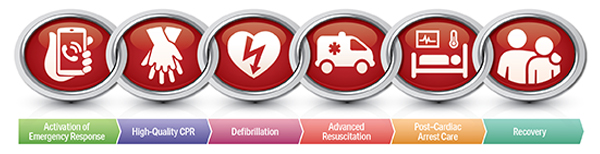
Recognition and Emergency Activation
The first step is recognizing the occurrence of a cardiac arrest, and contacting emergency response (calling 911)
High-Quality CPR
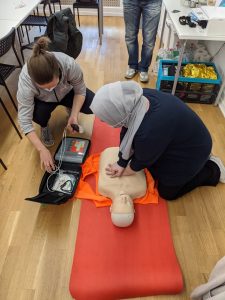
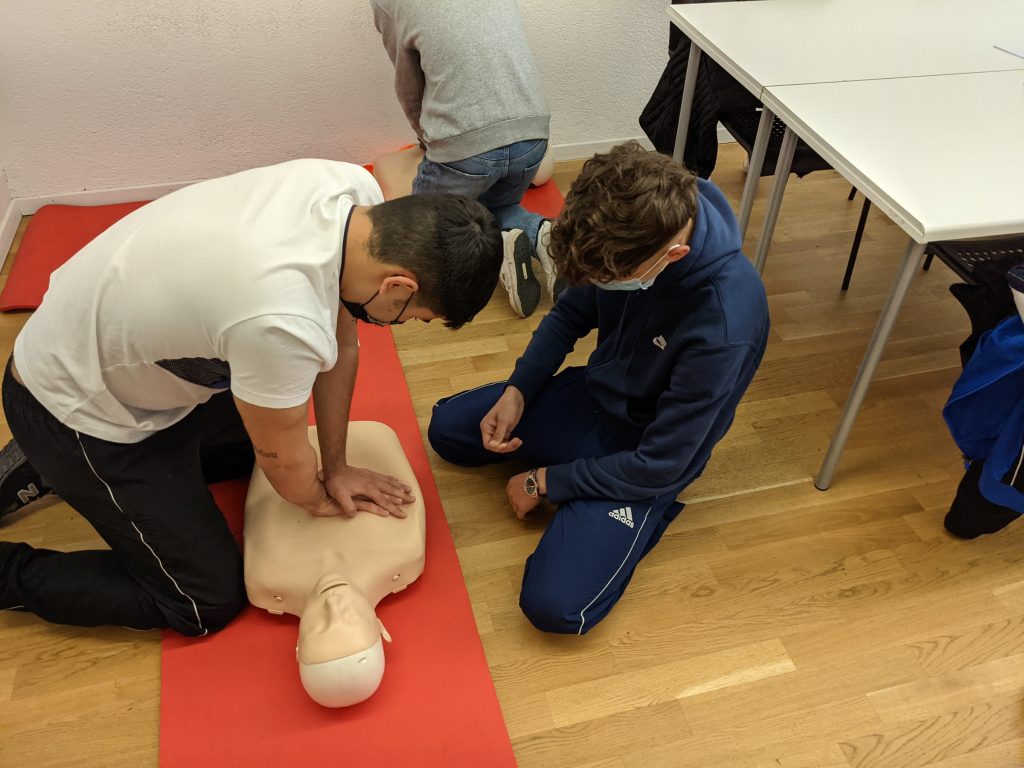
Next, perform CPR as quickly as possible – this can be hands-only CPR with an emphasis on chest compressions.
Watch how to Perform Hands-only CPR
Defibrillation
Use an AED if one is available, and follow the prompts to deliver defibrillation.
Step by Step: How to Use an AED
Advanced Resuscitation
Once emergency medical responders arrive, they will perform resuscitation and advanced care.
Post-Cardiac Arrest Care
Following a cardiac arrest, patients are provided comprehensive medical treatment and support to optimize outcomes and chances of survival.
Recovery and Survivorship
The last steps for the cardiac arrest patient are recovery treatment, rehabilitation or observation as needed.
A Bystander’s Role in the Chain of Survival
The first three steps of the chain must often be performed by bystanders, whether or not they know the patient. If nothing else, it’s vital to understand when a sudden cardiac arrest is taking place, and to call 911.
But performing CPR as soon as possible is key to improving outcomes.
According to data from 2024, while only about 1 in 10 people survive an out-of-hospital cardiac arrest, immediate bystander CPR can double or even triple a person’s chances of survival. And because about 70 percent of cardiac arrests take place in the home, the life you save may be that of a family member.
How CPR Training Helps You Stay Prepared
If you do not have to have an active certification to perform CPR, however, routine CPR training can help you stay prepared, confident and enhance your overall technique and accuracy.
Many individuals first decide to take CPR and first aid training primarily because they want to be prepared and keep their families safe. Some may take CPR training because their employer offered it, and others want to contribute to the safety of their community.
A recent survey from the American Red Cross found that adults trained in CPR, AED, and First Aid reported positive outcomes: 69% felt more prepared, 63% felt more confident, and nearly half felt relief knowing they had the skills to act when it mattered most.
Common Questions About the Chain of Survival
What is the most important link in the chain of survival?
Recognizing an emergency comes first. In the event of a medical emergency, instinctively we want to help the person, but it is crucial to first call 911 for professional medical assistance and then perform CPR immediately after.
What is the difference between the out-of-hospital and in-hospital chain of survival?
Out-of-hospital, just as it sounds, refers to a cardiac medical emergency that occurs anywhere outside of a hospital setting. As expected, chances of survival are lower, but proper training and action from bystanders can significantly help improve outcomes.
How long does it take to get CPR certified?
CPR certification can be completed in as little as 2-4 hours. HeartCert has flexible CPR and first aid training options from in-person, blended and online courses to seamlessly fit your schedule.
Be Ready to Take Life-Saving Action
A medical emergency can happen to anyone, anywhere, any time. In those critical moments, survival may depend on your ability to recognize the signs, call emergency services, and take action with life-saving CPR and an AED.
Don’t wait for an emergency to happen. Learn how to be the most critical link in the Chain of Survival.
Schedule a CPR training course today.
Sources:
https://pmc.ncbi.nlm.nih.gov/articles/PMC6088442/
https://www.redcross.org/take-a-class/resources/articles/cpr-facts-and-statistics
This is an updated blog original published in 2021.
HeartCert is your trusted training partner for CPR, ACLS, PALS, EMR, First Aid, CNA, TMA, IV, EKG and more, throughout the United States.
HeartCert CPR courses include CPR/AED/First Aid and CPR/AED, Basic Life Support (BLS), Advanced Cardiac Life Support (ACLS), Pediatric Advanced Life Support (PALS), and Certified Nursing Assistant training. Courses and certifications from both the American Heart Association and American Red Cross are available.
We offer virtual courses and certifications, in all 50 states as well as in-person classes at our headquarters, HeartCert CPR Eagan and major cities in Iowa, Illinois, Michigan, Minnesota, Missouri, Mississippi, Nebraska, Pennsylvania, Texas and Wisconsin.